Introduction: you want to enclose your terrace, but you live in a community
You have decided to enclose your terrace. You want to shelter it from the wind, the dust and the afternoon heat, and enjoy it for more months of the year. But you live in an apartment building and, before thinking about frames and glass, the inevitable question comes up: what will the owners' association allow me to do?
It is one of the most common questions we receive in Granada, Malaga and along the Costa del Sol. The good news is that there is almost always a solution that respects the building's facade and lets you enjoy your terrace. In this article we explain the two main options, a framed enclosure and a glass curtain, how they differ and what to check before you decide.
💡The key ideaA glass curtain is an enclosure too. When the community does not allow visible frames, it is usually the option that fits best, because it barely changes the look of the facade.
Why many communities set limits
A building's facade is a shared element. Even if the terrace is for your private use, its outer face is part of the image of the whole building, which is why many owners' associations regulate what can be installed on it. The reasons are usually sensible:
- Visual consistency: avoiding a situation where every neighbour encloses their terrace with a different system, colour and proportions.
- Protecting the facade: some buildings have architectural value that the community wants to preserve as it is.
- Common elements: railings, slabs and terrace fronts may be common elements, and changing them usually requires agreement.
- Existing criteria: some buildings already have an approved enclosure model, and new ones are expected to match it.
That is why communities often do not allow visible aluminium frames, or require the enclosure to be as discreet as possible.
Option 1: framed enclosure
This is the classic enclosure: a structure of aluminium profiles with sliding, opening or fixed panels that closes the terrace tightly. When the profiles have a thermal break, the enclosure performs like the rest of the house: it does not condense, it keeps warmth in during winter and coolness in during summer, and it turns the terrace into an extra room you can use all year round.
It is the solution we recommend when you want a climate-controlled space, such as a study, a dining area or an extended living room. We explain it in detail on our glass room page and in our guide to terrace enclosures.
Its main limitation in apartment buildings is precisely the visual one: the frames can be seen from the street. Although there are finishes and colours that blend in very well with the facade, some communities do not accept them.
Option 2: glass curtain
A glass curtain is a system of tempered glass panels with no vertical frames between them. The panels slide along an upper and a lower track and, when you want to open up, they swivel and stack to one side. Fully closed, the outside view is an almost continuous surface of glass; fully open, the terrace is a terrace again.
That is why it is usually the option that fits when the community does not allow frames: the look of the facade barely changes. You can see how we work with this system on our glass curtains page.
What you should know
A glass curtain has no thermal break at the bottom and is not an airtight closure: there is a small joint between the panels. This means it does not turn the terrace into a climate-controlled room the way a thermal break glass room does. It protects very well against wind, rain and dust, and greatly extends the season in which you can use the terrace, but it is not meant to perform like a wall.
The role of solar control glass
In Andalusia, the main enemy of a glazed terrace is usually the summer heat. That is why solar control glass makes a lot of sense in glass curtains: a coating on the glass that lets light through but reflects much of the radiation that causes heat. The result is a bright terrace where the heat is greatly reduced, without giving up the view.
Thermal break frames or glass curtain: comparison
The mixed solution: thermal break roof and glass curtain
You do not always have to choose one or the other. On penthouse terraces or spaces with their own roof, a combination that works very well is a roof with a thermal break structure and insulated panel, with a glass curtain at the front. The roof provides insulation and silence when it rains, while the curtain keeps the facade clean and lets you open the terrace completely on good days.
We design this solution case by case, because it depends on the existing structure, the orientation and what the community allows. What matters is that the design is thought through as a whole from the start.
What to check before you decide
Before ordering any enclosure in an apartment building, we recommend reviewing these points. We say this with caution, because every community and every municipality is different:
- The community's statutes: they may include rules on the facade or on terrace enclosures.
- Resolutions of the owners' meeting: some buildings have already approved a model, a colour or a type of system for all owners.
- An early word with the president or the property manager: presenting your proposal before installation avoids misunderstandings. A few photos or a sketch help a great deal.
- Local regulations: the town hall may require some form of application depending on the enclosure and its location.
✅We are with you along the wayWe never assume an enclosure needs no permit, and we do not promise what is not in our hands. What we do is advise you on the paperwork your particular case needs and prepare the technical information on the system so you can present it to your community.
How we work
Tecnisun is a two-person family business with more than 25 years in the trade: we started in 1999 in France and have worked in Andalusia since 2011. Enclosures are our speciality. For enclosure profiles we work with INSTALLUX, and we are official installers for STRUGAL, SAXUN and FAKRO.
We study each terrace before proposing anything: the structure, the orientation, possible leaks and, in apartment buildings, what the community allows. The manager is on site at every installation, together with our professional partner installation team, and takes care of the finishing touches and final adjustment. Whether your home is in Granada, Malaga or on the coast around Marbella, you can see all the options on our enclosures page.
Frequently asked questions
Does a glass curtain need the community's approval?
It depends on each community's statutes and resolutions. Because it changes the facade so little, it usually meets fewer objections, but it is always worth checking before installation. We advise you on the paperwork your case needs.
Can I use a terrace enclosed with a glass curtain as a room?
You can enjoy it for many more months of the year, but it is not a climate-controlled room: the curtain has no thermal break at the bottom and is not airtight. If you want a space that performs like the rest of the house, the option is a thermal break framed enclosure.
Does solar control glass make the terrace darker?
Not noticeably. It is designed to let light through while reducing the heat from solar radiation. We recommend the most suitable glass according to the terrace's orientation.
Can an insulated roof be combined with a glass curtain?
Yes. It is a very attractive mixed solution: the roof provides insulation and silence, and the curtain keeps the facade clean and lets you open the terrace completely.
What do I need to request a quote?
Approximate measurements and a few photos of the terrace are enough to get started. If you know what your community allows, tell us that too: it helps us propose the right option from the outset.
Want to enclose your terrace while respecting the facade?
Tell us about your terrace and what your community allows. The online quote is free and without obligation, based on your measurements and photos; the technical home visit has a cost, which we tell you before arranging it. You can also call us on +34 627 84 14 04.
Request an enclosure quote →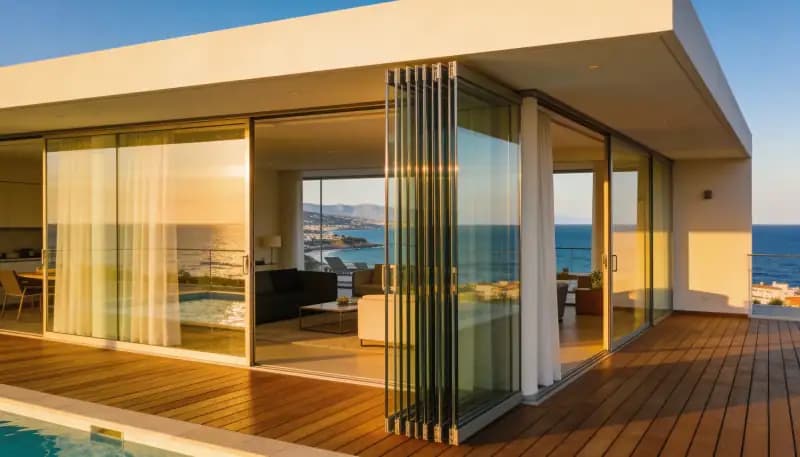 Glass Curtains